Saturday, August 16, 2014

Military Experience & the Arts

Military Experience & the Arts
MEA is a 501(c)(3) non-profit, volunteer-run organization whose primary mission is to work with veterans and their families to publish creative prose, poetry, and artwork.
Our volunteers are based all over, including college professors, professional authors, veterans’ advocates, and clinicians. As such, most of our services are provided through email and in online writing workshops.
All editing, consultations, and workshops are free of charge to those accepted for publication. Veterans and their families pay nothing for our services, and they never will. More here.
Steve Beales / Hope & Fear / The Journal of Military Experience, Vol. 2

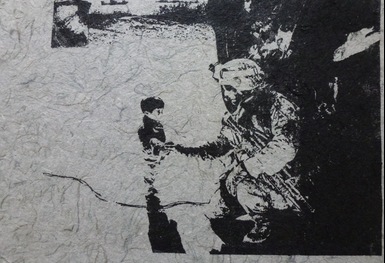
Making Your Own ‘Combat Paper’: A Step-by-Step Tutorial


More here and here.

Veterans art show in West Haven promotes healing from war, trauma


Just behind the pain


Where Connecticut Avenue and 18th Street converge in Washington, DC, there sits a statue of Henry Wadsworth Longfellow decked in his collegiate robe and duly contemplating. I came across him as I hunted for a place to take a lunch break from a conference on what the Humanities have to say on trauma. It amazed me how many experts in fields such as medicine, mental health, and the military had crowded the halls that morning, seeking out sessions on narrative, film, and ancient classical drama. Why then were these highly skilled, obviously well-off specialists flocking in to learn about the Humanities? What could it possibly have to offer a victim of violence, a person ravaged by illness, or a suicidal veteran?

I sat down under Henry, munched on a spinach empanada, and mulled over a quote of his I had often thought of in my own efforts to come to terms with and write about the experience of trauma, particularly that caused by violence:
If we could read the secret history of our enemies, we should find in each man’s life sorrow and suffering enough to disarm all hostility.
Pragmatically-speaking, and by all outward appearances, an eye for an eye makes perfect sense. But just beneath the surface, where compassion resides, such “justice” can be seen for what it is—simply a perpetuation of forces that create suffering in the first place, and so it loses all its sense.

I don’t know of any way to arrive at this conclusion other than in the Humanities, which tends to illogically turn rules in on themselves.

As I was walking the two blocks back to the hotel, I came across another writer, this time leaning against the
hotel wall and smoking a cigarette. It was Tim O’Brien. I asked him, was it healing to write all that he had written on the Vietnam War? Tim said he does not know what healing is. But writing was a chance to dive into the wreck and salvage something.

Then I heard him talk. In his speech, he managed to show the insanity in our sanity and the sanity in our insanity, and therein lies much of the grace in the Humanities. It is Lear’s fool. Through its weird wit it gives us unpalatable truths and calls us to be better than we are. “This is you,” it says, “and you can only have seeing eyes by every now and then walking the walk of another.” Sometimes rather than urging us to pick up more knowledge, it begs us to lay down what we know and walk through experience naked of insight. Doing so allows for the field to lie fallow so that eventually a richer understanding can rise inside us. But that takes time and bafflement and a sort of yielding that makes us squirm.

If we are living at all, we live in paradox. We are all victims and perpetrators of contradiction to a greater or lesser degree. Cognitive dissonance is that uncomfortable feeling of holding two contradicting ideas simultaneously. The discomfort comes in the form of surprise, dread, guilt, anger, or embarrassment. To reduce it we choose one of two actions:  we change or we lie.

Successful art catalyzes that process, and you can feel the shift in an auditorium just after a play or an earth-shaking speech like Tim O’Brien’s. Often the directions are mixed. Some are profoundly moved, some frame the experience within a construct they have not escaped and so fall into justifying, blaming, denying, or happily tucking away the cell phone they reprogrammed throughout the event. You cannot make people take what you want them to out of a work of art. Art is and always will be only an invitation. Keats’ famous maxim “Beauty is truth, truth beauty” suggests that to allow, even invite cognitive dissonance and purposefully experience surprise, dread, guilt, anger, and/or embarrassment in search of truth can lead one to gain a larger, deeper perspective, where the angels of the human psyche—compassion, empathy, connection, dignity, and integrity—reside just behind the pain.

Writing Can Help


Writing Can Help is a new group led by a 30-year veteran for those who have experienced trauma. Its purpose is to encourage release, hope, help and healing through writing.

When an injury in Iraq concluded thirty years of military service for Jerry Bradley, he turned to writing as a cathartic outlet. Since then, he has been actively involved in Fayetteville’s writing community, serving as
“Remember, disabled does not mean unable.” 
President of the Writer’s Ink Guild and helping to launch Methodist University’s Veterans Writing Collective. Knowing how much writing has helped him, Bradley wants to bring those same benefits to people with a similar background: military men and women, retirees, veterans, government civilians, battlefield contractors, first responders and their family members who have experienced or who are experiencing events resulting in mental (such as PTSD and TBI) or physical trauma and disabilities. “This will be,” says Bradley, “an environment in which members feel comfortable and free to express themselves while developing and learning the benefits associated with writing in a positive and productive manner.”

There will be workshops, discussion groups, critique groups, special projects, and guest speakers.

When: Saturdays, twice monthly at 10:30 AM
Meeting Location: Room 202 of the General Classroom building (All American Veteran Center/Book Store Bldg.) on the Fayetteville Technical Community College (FTCC) Campus.

Visit us online or call/email the facilitator, Jerry Bradley.
Phone: (910) 574-5019
Email: writingcanhelp@gmail.com
Facebook: https://www.facebook.com/Writingcanhelp
Meetup: http://www.meetup.com/Writing-Can-Help-Patriots-Artist-Guild-of-Fayetteville-NC
Website: http://writingcanhelp.webs.com/

Wednesday, August 13, 2014

The library so far


It's a start, humble but earnest.

War and the Humanities--a vital connection?

You might think there is no connection whatsoever, let alone a vital one, but I think there is.

Cognitive dissonance gets alchemized through art into paradox. 

And when you're talking about war, that's huge, because experiences in war have a way of creating deep cognitive dissonance--
the mental stress or discomfort experienced by an individual who holds two or more contradictory beliefs, ideas, or values at the same time, or is confronted by new information that conflicts with existing beliefs, ideas, or values. 
Jonathan Shay posits that cognitive dissonance is a major contributing factor in the complex we call PTSD. We all hate cognitive dissonance. It creates riots, arguments, depression, anxiety, even substance abuse. It makes for a lot of unresolved tension.

Now let's look at a golden word used by those in the Humanities: paradox--
a statement that apparently contradicts itself and yet might be true.
Through paradox, contradictory elements are reconciled. Tension moving toward resolution, however uneasy, makes art come alive. Art allows the insufferable experience that can plague and alienate to become, as Ed Tick points out, not only processed but communalized. Many of the greatest works of art and literature stem from experiences in war--because they were the necessary footwork to do in order to recover from war.


When I put these two together--cognitive dissonance and paradox--I wanted to shout this connection from the tallest mountain, because you see, I truly do believe that this is how story heals...or at least makes life easier to live.

Welcome! I'm glad you're stopping by.